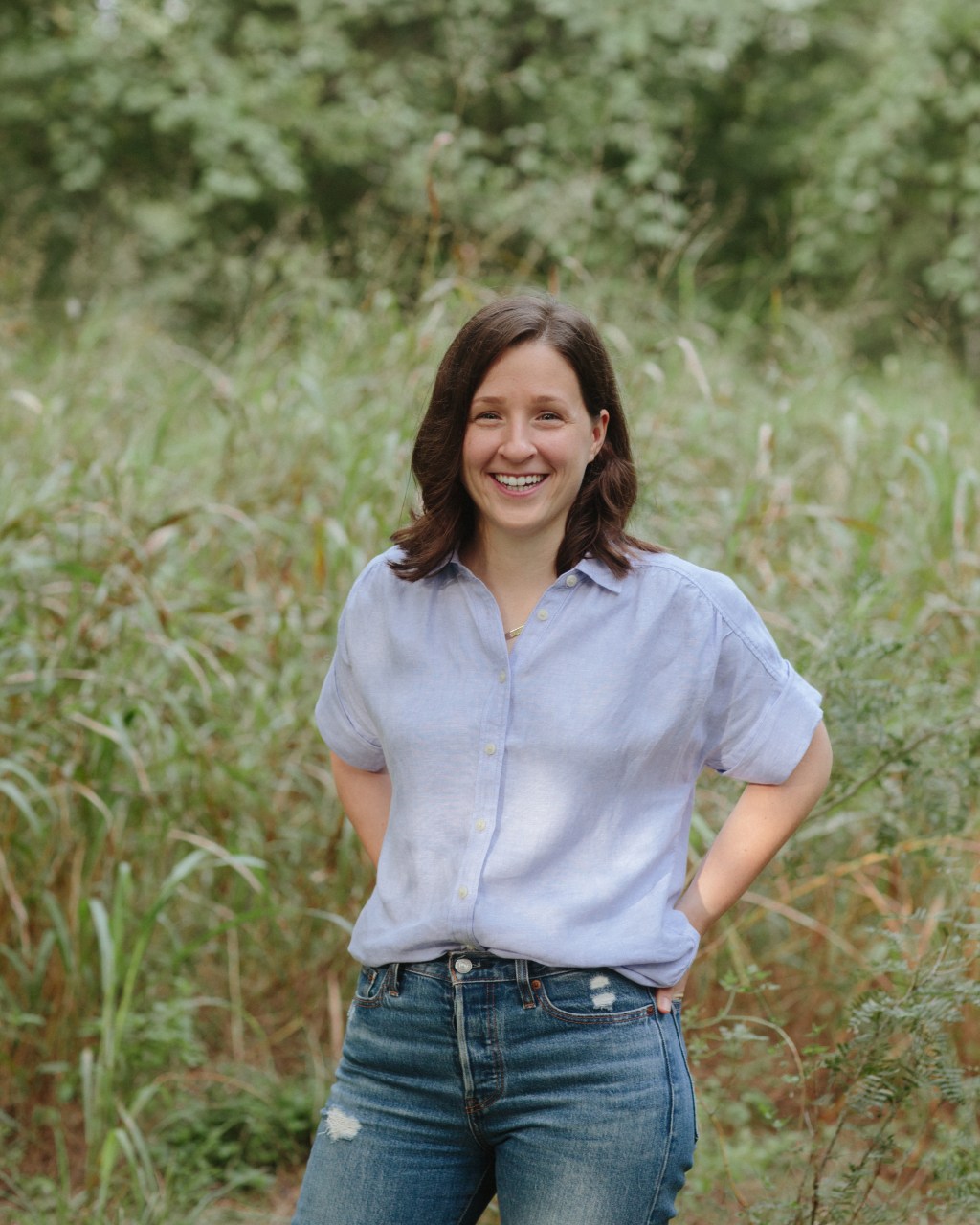
Founder of Sister Seasons
“The oppressive systems that led to climate injustice are the same forces behind gender injustice.”
Rebecca (she/her) became a feminist climate justice activist after her own journey with learning to care for her menstruating body in relation to caring for the Earth. At Sister Seasons, she works to guide women and all menstruating bodies to restoring their wellbeing through awareness of rhythms in nature and their own bodies. Drawing from climate science, ecology, alternative medicine, and intersectional feminism, she empowers women and menstruators to care for their bodies as a way to expand their capacity to care for themselves, their communities and the planet. In her personal narrative, she discusses the power of the menstrual cycle and recognizing how toxic pollution harms women’s bodies.
Political Awakening as Climate Justice Activist
Meg: How did you become involved with feminist climate justice activism?
Rebecca: My journey as a feminist environmental activist has not been a linear path. A lot of that journey has involved figuring out where my unique place was in the climate movement. I became interested in environmental issues back in eighth or ninth grade, and wove my way through studying environmental issues and working in nonprofits. I spent seven years working on sustainability within a very progressive feminist corporation, which I admit might sound like an oxymoron.
While I was doing work for that company, I ended up having my own light bulb moment that my personal lived experience as a woman, and all the health issues that I was seeing the women around me have, were parallel to what the earth is experiencing due to climate change. It was just this huge “Aha” moment. I had believed that my paths as a woman and as a sustainability professional were separate. But then I had this moment of realization that my work with women and my work around climate change were intimately connected. That led me to found my company, Sister Seasons, in 2020. Sister Seasons educates women and menstruators on how to work with nature for their wellbeing and our planet’s wellbeing.
The process of building Sister Seasons helped me uncover my own story. Because there is such an incredibly deep connection between gender equity and climate change, there’s still a lot more that I have yet to understand about my lived experience. As part of my work with Sister Seasons, I’ve been researching and observing parallels between health and well-being challenges for women, as well as the issues our planet is facing as a result of climate change. It’s been really fascinating to explore an issue that’s happening for women, and then see how that is mirrored in nature.
One really personal example of these parallels is that I’ve had a lot of experience struggling with burnout over and over within my academic and then in my professional career. At the end of 2019, when I left my corporate job and became self-employed, I really thought that pattern was going to end. But it didn’t. And, you know, we’ve been in a pandemic. So having a lot of self compassion is important. But in that process, I realized that it wasn’t just external cultural forces that were pushing me to this state of burnout. It was also all of these beliefs within our culture that I’d internalized that worthiness is connected to productivity. I think that that is so magnified for women and non-binary folks, because we aren’t valued in this culture. And we certainly aren’t guaranteed safety. I’ve often found myself overriding what my body is telling me, which causes me to burn out through overwork and avoiding rest or stillness. I think those same cultural beliefs that have caused me and many others to burn out are the same beliefs that are causing us to push our planet to burnout.
The process of seeing that parallel helped me have so much more compassion for myself, because I can draw upon the compassion that I feel for the planet. Seeing the planet going through the same thing that I am helps me have more compassion for myself. And then I can return that compassion to the planet as well.
Personal Experience with Birth Control
Meg: How have your personal experiences informed your approach to environmental activism?
Rebecca: I was on birth control for a handful of years, starting in my 20s. When I turned 30, I hadn’t had a period in many years and I felt like it was time to get off of the pill. And at the time, I was still under the impression that when you were on birth control, you had a period. I didn’t even know what was happening to my body when I was on birth control. But I felt like a big part of myself was dormant and shut down while on the pill. Deciding to go off of the pill felt like an opportunity to meet myself again. Once I came off of it, I experienced the world as so much more colorful. I could access such a bigger spectrum of emotions again. I started to notice the rhythms of my own body. Being on the pill cut me off from so much information my body was trying to give me. Going off the pill was a really powerful experience of meeting my full self again.
I do want to add that I strongly believe we all have the right to choose the birth control method that works for us. It is so personal. I would never say that anyone shouldn’t go on birth control or hormone therapy. It definitely served a very important purpose for me for a time. But I do think we deserve to be educated on the side effects, so we can make informed decisions. And I also want to be honest that the experience of coming off of the pill was a huge turning point for me, not only for meeting myself as a woman, but also for beginning my journey to founding my organization, Sister Seasons.
After going off the pill, I went through all the emotions, but one of them was anger. I felt really angry that no one had ever told me how my body worked. And that I could be a 30 year old, highly educated woman who had graduated from college and didn’t know what was happening in her body and her menstrual cycle each month. That anger has fueled my passion for helping other menstruators to have access to that same information.
So, when I got off of birth control and started learning about my own menstrual cycle, a lot of the resources that I was discovering focused on the four phases of the menstrual cycle. There are some great teachers who taught me how these four phases are a microcosm of universal cycles, such as the cycles of the moon and the four natural seasons. But what felt like it was missing from their approach was empowering people to know that this knowledge is all around us and we can learn it directly from nature. This is important because information about how our bodies work, especially as women, has not been accessible to all of us. We need to break down barriers to this critical information that can show us how to care for ourselves.
Women are often infantilized within the traditional medical system and our pain and concerns are often invalidated by doctors. That’s not to say all doctors. But the system as a whole really is not a resource for women to get practical information about how their cycles work. When we start looking to nature as a teacher, we are able to get that information that we maybe haven’t been able to get elsewhere. It goes beyond just health education too. We are powerful as women and menstruators because each phase of the menstrual cycle comes with its own gifts.
Connecting Feminism and Climate Justice
Meg: How do you see the connections between feminism and the climate justice movement?
Rebecca: You cannot have climate justice without gender justice. The oppressive systems that created climate injustice are the same forces driving the oppression of women and nonbinary people.
So, at the end of the day, valuing all genders equally and valuing our planet are the same. That’s one of the reasons why intersectionality is so incredibly core to this work. Women of color, trans and queer women, and all women with multiple marginalized identities are experiencing the impacts of gender inequity and climate injustice to a greater degree. We need to address gender inequity, racism and the climate crisis together. We can get to a more just future much faster and more effectively by addressing these injustices together.
I think it’s also really powerful to see that connection, because I do see a lot of my friends, family and peers who are feeling intimidated or helpless about climate change. And so I can ask them about their other activism: are you doing racial justice work? Are you doing gender justice work? And if you are, that’s great, because they are all different doors into this future that we want to create. If you’re doing antiracist and feminist work, then you’re likely doing climate justice work because you are addressing the oppressive systems that are harming both marginalized people and our planet. There are many doors into a more inclusive, equitable, and sustainable future.
I wish people knew that climate change disproportionately affects women globally. I didn’t know that for so long, and I’ve been working on environmental issues for so much of my life. I want to specifically acknowledge Osprey Orielle Lake from Women’s Earth and Climate Action Network (WECAN), whom I first learned that from. Her organization’s work also helped me understand that women have so much knowledge, wisdom, and personal experience that could help us create better solutions. When you bring people with diverse identities to the table, they offer diverse ways of thinking. If we include women, non-binary folks, and trans folks when we’re developing climate change solutions, we are going to build more effective and sustainable solutions. Yes, women are disproportionately affected by climate change, but there’s also this incredible opportunity for uplifting their wisdom, knowledge, and lived experience. Women, non-binary folks, and trans folks are the holders of our climate solutions.
Those of us who live in bodies that are not cis male have directly experienced the same injustices, inequities, and violence that harms our planet. Menstruators store nutrients in different ways than male bodies. This is part of nature’s most beautiful, intelligent design: if a body might potentially create life, it needs to make sure that it has all of the nutrients to feed and nourish a potential new life form, and our bodies are so wonderfully designed that they do this. But this also means that we’re more susceptible to toxins that are polluting our water and air and chemicals, including those in cleaning and beauty products, many of which mimic estrogen and are known as xenoestrogens.
As women, trans, and non-binary people, we are feeling what is happening to our planet on such a deep physical level. The same toxins that pollute the natural world around us also pollute our physical bodies. Our personal experiences with violence committed against our bodies mirror the extraction and destruction directed at our land, water and air. The deeper I go into this work, the more I so clearly see that what we’re experiencing as women, trans, and non-binary folks is just like what our planet is experiencing. And for me, this means that we don’t have to be a climate change expert to show up and speak up for the planet. We know what the planet is going through, because we experience it at the individual level of our own bodies. It’s emotional for me to even talk about, because there’s so much grief that can come up when we really acknowledge that.
Feminism & Climate Just Futures
Meg: What could a climate just future look like?
Rebecca: In a climate just future, I see a lot more rest and regeneration of not just our planet, but of ourselves as individuals and as communities. There would be more collaboration and less competition, including recognition of how much there is on our planet that we can all share. I envision us restoring a reciprocal relationship with nature and with each other, learning how to give and receive. In a climate just future, we would listen more to one another.
I learned from adrienne maree brown that we can bring this future into being now by practicing it with ourselves and each other in our everyday lives, even when big structures of power have not yet shifted. It can be as simple as giving ourselves permission to slow down. I have this quote from adrienne maree brown on my desk that says that we need different kinds of thinking to address the environmental crises. As she writes, “There is such urgency in the multitude of crises we face, it can make it hard to remember that in fact it is urgency thinking [as in constant, unsustainable economic growth] that got us to this point, and that our potential success lies in doing deep, slow, intentional work.” I welcome this reminder that how we build the future will determine what future we create.
Interview conducted by Meg Perret. This interview was produced as part of a project of Our Climate Voices, and led by Project Director Meg Perret.
 Queer Climate Futures