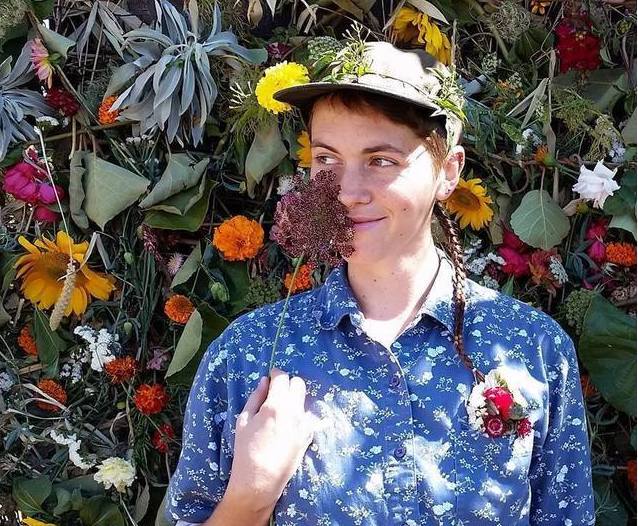
Co-Founder of Queer Ecojustice Project
“I choose to reject the gender binary because it is at its roots a colonial structure that causes harm to both bodies and the land.”
As a co-founder of the Queer Ecojustice Project, Vanessa (they/them) approaches ecological issues through a queer lens. Vanessa is the director of Fire and Flood: Queer Resilience in the Era of Climate Change, a film that documents how Hurricane Maria in Puerto Rico and the fires in Santa Rosa, California harmed the LGBTQ community. Vanessa draws from Black and Indigenous thought, introducing a paradigm in which we exist in relation to the earth rather than apart from it. For Vanessa, it is only through this radical embrace of queerness that we can appreciate the natural diversity of the earth and develop restorative solutions to ecological crises.
Exploring Queer Identity
My name is Vanessa, I also go by V and use they/them pronouns. I was assigned female at birth and still deeply respect the feminine aspects of my being. I’m so, so grateful for my experiences in women’s safe spaces, which really brought me to the consciousness I have now. So, I feel very comfortable with she/her, but I do not feel those pronouns convey the multiplicities of my experience in being.
I am not an individual, but rather, I am in a relationship. My relationship is in opposition to the normal. I fell in love with a trans man and at that point the term bisexual didn’t feel like it fit me anymore, and queer felt expensive and like it could hold me. Through reading Stone Butch Blues by Leslie Feinberg, I thought that I may also not just be a woman, and that was big for me. I am more interested in the idea that gender performs something when I walk around the world.
I’m a white person with hazel eyes, and my hair is like some kind of weird, shaggy, moldy transitional art piece or something. I have a faint mustache coming in which I’ve been taught to call a dirt stash, and today I’m wearing a floral sweater. When I walk around the world, I choose to reject the gender binary because it is at its roots a colonial structure that causes harm to both bodies and the land. I’m a grad student at University of Georgia and there is a very strict frat and sorority gender binary that’s shared amongst many students. Those of us who are different stand out, and some of us cannot hide what makes us different. Some of us choose to be different, even when we could choose assimilation. How we choose to enact our gender matters.
When individuals visibly stand out as different during times of disaster, this is dangerous as it puts them at higher vulnerability to a number of different kinds of violence. I think it’s important when we’re talking about gender to think about how there’s both an internal gender experience, and there is also a gender presentation that does things in the world.
Coming of Age as a Queer Environmentalist
Meg: What inspired you to become involved with queer and environmental activism?
Vanessa: My work in the climate movement and in gender justice activism are long and entangled journeys, though I approached them separately for most of my life. At the same time that I first came out as bi at 13 and had my first girlfriend, I also started doing different kinds of environmental work. I went to high school in Kenya, at the International School of Kenya in Nairobi. That experience really grounded my approach to environmental justice and climate justice.
My first role model in the environmental movement was Wangari Maathai. I even had the opportunity to meet her while in school. She founded the Green Belt Movement in Kenya, an organization that still works to empower rural women to become leaders in their communities by starting their own nurseries and reforestation efforts.
The lessons I’ve learned from coming to know Wangari Maathai and her story have stayed with me. At the root of it, those lessons taught me that there’s an intimate connection between the struggle for women’s empowerment, the struggle against global capitalism and neo-colonialism, and the struggle to defend and restore the earth. There’s nothing apolitical about planting a tree. I came to consciousness as a feminist and environmentalist through this perspective. Yet, even during this very foundational moment in my life, I still kept those two parts of my activism separate.
I look around the environmental movement, and it is hella queer. There are so many queer and trans people in the environmental movement. So many of these folks have diverse, expansive gender identities and presentations, especially within the youth climate movement that I was a part of. Yet, we never really talked about how our identities connected to the environmentalist work that we were doing. It really wasn’t until graduate school that I started explicitly putting the two of them together. I had a semester where I was a Teaching Assistant for ecofeminist Carolyn Merchant and also taking a seminar with Black feminist Carolyn Finney. The class gave me permission to start to think about the intersections of gender, race, class, sexuality, and the earth. More specifically, it allowed me to put my own experiences as a queer, gender deviant, and anti-binary person, into the conversation with the environmental work I do.
Founding the Queer Ecojustice Project
Meg: Could you tell us about your Queer Ecojustice Project?
Vanessa: It was after that semester that I started the Queer Ecologies Project, now called the Queer Ecojustice Project, with my good friend, Desi Fantino. This started as a reading group looking at the intersections between queer liberation and ecological justice. Four years later, my interests in queer ecological justice still propels my PhD work, and my work as a filmmaker. My film, Fire and Flood: Queer Resilience in the Era of Climate Change, is a collaborative documentary project that shows the experiences of queer and trans folks who experience climate disasters. I am making this film because their stories are so rarely heard and told. It focuses not just on the systematic oppression of queer and trans people that make them more vulnerable during times of disaster, but also the histories and legacies of resistance and resilience to that oppression.
The Fire and Flood film started out of my personal experiences during the fall of 2017, when the Tubbs fire, along with thirteen other fires, erupted across Northern California. I was hosting the queer magic center, which is a space for queer and trans people in the permaculture and agroecological movement to come together and to celebrate each other. We also explored queer and trans ecological knowledge and shared our magic with each other. I can’t even say in words what a transformative experience hosting that space was for me, and a number of people have shared this same sentiment.
Monday morning, we woke up to the smoke of thirteen fires surrounding us and the news that three of the four major evacuation routes were closed. The only way out was to go to the sea, hang out on the beach, and hope that we could make it out. I was really grateful to be at the permaculture convergence surrounded by a community of people that think about and prepare for disaster.
For the next two weeks, I thought, I have to do something, anything. I volunteered with local sustainable agriculture programs and urban farms to distribute food to evacuation shelters. I also went to the LGBTQ center in Santa Rosa, which does incredible work for queer and trans folks up in Sonoma County. I would sit with them and hear heartbreaking stories of the awful experiences that they had in the shelters. There was a young neurodivergent foster youth from a group home who told me this story of the time there was one staff person on the overnight shift. In shelters, there is so much overstimulation. The lights were super bright, and there were police with assault rifles at the door. This young person started having a panic attack, but did not have access to their medications. The volunteer medic who came to help out did not understand their neurodivergence and also misgendered them repeatedly. Queer and trans people have disproportionately higher levels of mental and emotional neurodivergence, and are also disproportionately institutionalized. And so, every aspect of this story is a gendered experience. This story made me realize that I cannot separate who I am as a differently gendered, anti binary person from my environmental activism.
When I think about my personal experience with gender and climate change, I realize that all of my experiences of climate change are experiences of my gender. I think that’s true of everyone, whether they directly see it or not. We should be asking: how does society force you to conform to particular roles and how does that influence your experience of climate change?
Queering Climate Justice
Meg: What does the phrase “climate justice means gender justice” mean to you?
Vanessa: Climate justice means gender justice is a way to understand how our concepts of gender are deeply entangled with the extractive economy that’s driving climate change. The binary gender system that was brought to this continent and spread through the violence of settler colonialism was explicitly set up to do violence against bodies and land. Settler colonialism required a toxic masculinity that could commit the violence of genocide and ecocide, and it required devalued reproductive and caring labor for the expansion of the settler population.
The gender binary has a history. This is a reminder that this is not the way that it has always been, and it is not the way it needs to be. Repairing a right relationship with the earth requires repairing a right relationship with our bodies. I think non-binary, gender non-conforming, gender critical people have some really important insights into how the status quo is maintained through gender, and how we can fight back against these systems through reclaiming our bodies. The gender binary, the extractive economy driving climate change, and the systems of control that make queer and trans people more vulnerable during those disasters are all connected. It’s also critical to have an explicit commitment to Two Spirit and queer Indigenous people who have been fighting back against settler colonialism, and still are. It is really important that they are centered and uplifted in this discussion.
Plenty of Two Spirit and queer Indigenous folks are at the forefront of the climate justice movement such as Candi Brings Plenty. As a climate justice community, we need to commit to decolonization. Decolonization is a path to uprooting the extractive economies that drive climate change and the social conditions that make queer and trans people more vulnerable to climate change.
It’s going to take us a minute to highlight how queerness and gender-expansive people are an extension of the beautiful bio-cultural diversity of this earth, or biological exuberance. I think we need to have a lot more education about queer ecologies. Ecological education needs to be imbued with queer ecologies. More people in the climate movement need to learn about ecology in general, and I think we need to spend more time with the earth. A lot of times we can get burned out and forget the love and the intimate relationship with the earth that we are trying to protect. We need to invest time in that relationship, and get in touch with the sacred cycles of life, even if you just have a little garden with tomatoes. Ecological education needs to be imbued with queer ecologies. I think rekindling love and curiosity for the earth is an important starting place for the climate justice movement.
Queer Ecological Futures
Meg: Can you tell us about how you imagine queer ecological futures?
Vanessa: People who have experiences of living creatively, outside of the systems of capitalism, and in opposition to the systems of settler colonial capitalism have a lot of the solutions that we need to face the climate crisis. This is something that queer, gender non-conforming, non-binary, and trans folks can lend to the climate movement.
The climate movement needs to listen to the importance of pleasure and being in our bodies, which are an extension of the earth. We need to understand that the pleasure of the body is not something sinful, but is important for our activism. We need to be fully loved, nourished, and embodied beings to fight these disembodied objectifying violent systems.
I think we’re in a moment right now of revival, like coming back to life. To me that looks like mutual aid, and interdependent, reciprocal, and caring labor for other bodies and the earth. The future should have no more prisons because we support and reintegrate those who have caused harm. In a just future, everyone has access to nutritious and culturally relevant foods, medicines, and sacred spaces.
I’m very indebted to queer, Indigenous, and Black studies, and old school lesbians of color, including activists who never went to institutions of higher education.
Thank you to all of the queer and trans ancestors who were born on this planet at a time when they couldn’t be who they were. I have gratitude to them for doing the small things and for bringing us to where we are now, even if we’ll never remember their names, even if their lives were cut short, even if they had to cut their own lives very short to escape the violence that they lived under. I’m just so grateful to them and to all of the young people who pushed me to be even weirder and freakier.
Interview conducted by Meg Perret. This interview was produced as part of a project of Our Climate Voices, and led by Project Director Meg Perret.
 Queer Climate Futures