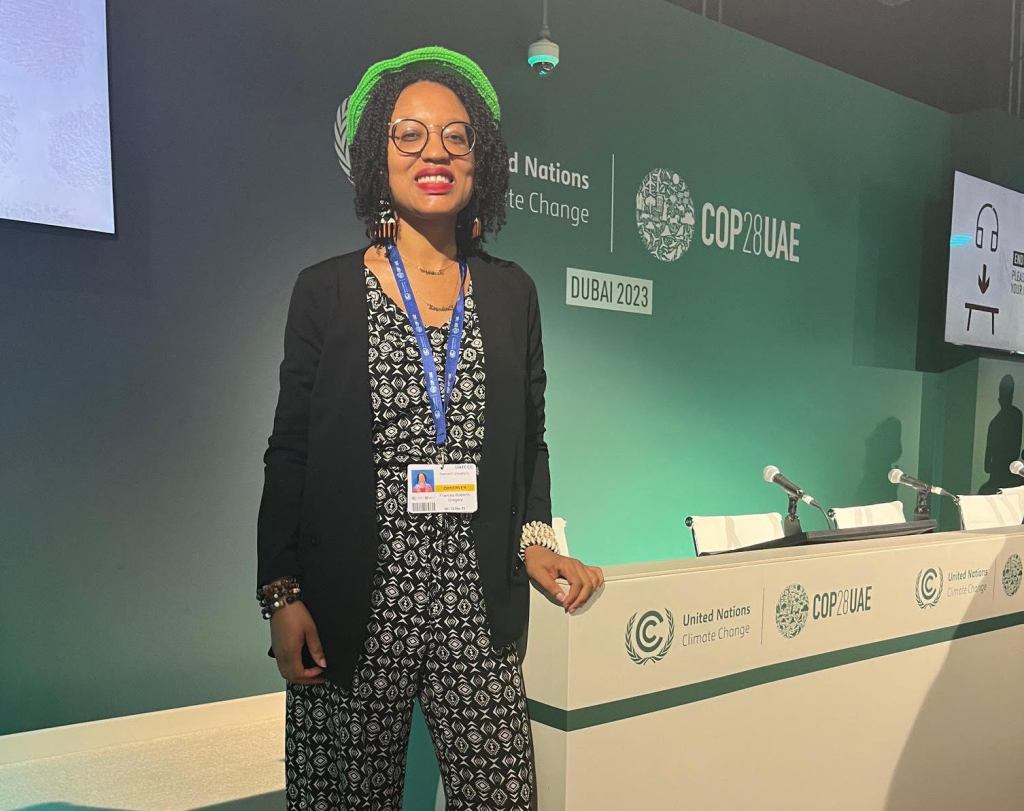
Feminist Political Ecologist and Steering Committee Member of the Feminist Agenda for a Green New Deal and the Hive Fund for Climate & Gender Justice
“Our personal experiences with violence committed against our bodies as women, trans, and nonbinary people mirrors the extraction and destruction experienced by the planet.”
Dr. Frances Roberts-Gregory (she/her) is a Black ecowomanist and feminist political ecologist who advocates for women of color and feminist environmental, energy, and climate justice. She is a co-founding member of the Feminist Agenda for a Green New Deal, a transnational feminist collaboration aimed at developing intersectional climate change policy. She also serves on the boards of the Hive Fund for Climate & Gender Justice and the HBCU Green Fund. Frances discusses how her personal experiences as a Black woman have shaped her approach to climate justice activism.
Ecowomanism
My name is Frances Roberts-Gregory. I identify as an ecowomanist scholar and activist. I am a postdoctoral fellow at Harvard University. My PhD is from the University of California, Berkeley, where I studied feminist political ecology and environmental science, policy, and management. Originally from the East Coast of the United States, I am a product of the Great Migration, or the relocation of African Americans out of the rural southern U.S. to the urban northeast, west, and midwest. I grew up in New Jersey, Virginia, and North Carolina, and I went to college at Spelman, a liberal arts institution for women of African descent in Atlanta, Georgia.
I was raised by a single mom who was a math teacher, interested in science, and also a part of Black feminist health collectives. She was a vegan and very eco-conscious in the late 80s and early 90s. She informs the way I live my life, my connection with nature, and why I’m so connected to my history. She taught me to advocate for myself because of my love for my community.
I also identify as a Black vegan, or plant-based. Veganism is a path to decolonize your diet and take control over your health. For me, my appreciation for veganism evolved from health and environmental perspectives. When I attended Spelman College, for example, I initially was an environmental science major. I learned about the health impacts of a meat-centric diet. My understanding of the importance of a plant-based diet really evolved over time to include not only the nutritional aspects, but the health, environmental, human rights, and animal rights aspects. I just know, for me, Black veganism really resonates with my health, and really resonates with my spirit and my feminist politics.
I’m also a survivor of sexual violence, housing insecurity, and many different types of violence, which all impact the way I see climate justice as an intersectional feminist issue. It’s very confusing to me when folks don’t look at these issues in an intersectional manner, or when they try to prioritize one identity over another. My identity as a Black person is deeply tied to my identity as a woman, and my identity as a woman of color is deeply tied to growing up financially insecure, and being the descendant of enslaved peoples and immigrants. There’s no way for me to look at climate justice without looking at what feminists scholars like Donna Haraway would call a partial perspective or feminist objectivity.
“Ecowomanism” refers to the idea of Black feminist environmentalism, or women of color feminist environmental activism. It was developed by Rev Dr. Melanie Harris in part from Black feminist Alice Walker‘s understanding of womanism in relation to feminism. Women of color, femme folk, and queer folk are often on the front lines of environmental violence, but are not always included in environmental decision making. We live in sacrifice zones, and experience multiple forms of intersecting violence. At the same time, we have unique solutions for environmental justice, climate justice, and energy justice. This is why our leadership is invaluable if we want to go about our political objectives in a new, better, more feminist, and innovative way.
Becoming a Scholar-Activist
Meg: How did you get involved with feminist environmental activism?
Frances: My work around gender and climate has its origins at UC Berkeley in the Division of Society and Environment. I was mentored by Carolyn Merchant, the mother of environmental history, Carolyn Finney, a feminist political geographer, and Louise Fortmann, a rural sociologist. These women really shaped my understanding of the relationship between knowledge, power, gender, and environmental decision making. My doctoral research thus explores how women of color in Gulf Coast Louisiana navigate contradictory relationships with petrochemical industries, resist environmental racism, and devise solutions for climate justice.
I didn’t always know that I would be a feminist researcher. In graduate school, I was encouraged to situate myself in my research, which inspired me to ask questions about the barriers and opportunities for women of color in the environmental movement. My current research trajectory is a result of my understanding of situated knowledge and partial perspectives, and my own journey to embracing embodied knowledge as a woman of color.
I furthermore have personal ties to three environmental justice communities. I likewise always say that environment, energy, and climate justice are linked. A lot of the activists who have historically been involved in environmental justice struggles are now involved in what are termed “energy and climate justice” struggles. This is because these issues impact the same communities that are often considered to be sacrifice zones or toxic communities. These communities are disproportionately impacted by pollution and also bear the brunt of rising greenhouse gases.
Through my research, I learned that responses to “un-natural disasters” such as hurricanes have gendered implications. For example, women of color, the elderly, and folk who are differently abled are often more severely impacted by “un-natural” disasters. Because of structural oppression, they’re not always able to recover at the same rate.
In 2017, after interning with the Environmental Grantmakers Association in Harlem, New York, I moved to New Orleans. New Orleans is also known as Bulbancha, an Indigenous Choctaw word that means “the land of many tongues,” to represent all the Indigenous people that have currently and historically called this region home. I got involved with and was inspired by many different environmental organizations and climate action groups, including 350 New Orleans, Justice and Beyond and the Deep South Center for Environmental Justice, who I worked with as a consultant. I also followed the work of amazing individuals with the Gulf Coast Center for Law and Policy, (now known as Taproot Earth) such as Colette Pichon Battle.
Feminist Agenda for a Green New Deal
Meg: Could you tell us about your feminist activism in the context of climate justice policy?
Frances: I somewhat serendipitously applied to present my ongoing fieldwork at the 2019 World Forum on Climate Justice, in Glasgow, Scotland. During the conference in Scotland, I became affiliated with international women’s organizations at the intersection of gender and climate, such as the Women’s Environment and Development Organization (WEDO) and the Women’s Earth and Climate Action Network (WECAN). I previously became acquainted with these organizations earlier in 2017, when I attended the People’s Climate March in DC. While there, I attended a forum where they discussed the role of Black and Indigenous, and women of color, in the climate movement. I didn’t formalize those relationships, however, until after I presented my research in 2019 in Glasgow, Scotland. Thereafter, I was contacted and invited to become more involved in their efforts to create a feminist response to the Green New Deal, a public policy proposal in the U.S. to address climate change. Since I was already a fan of their work, I responded, “yes, I’m totally down for the Feminist Agenda for a Green New Deal!” I became involved in this collective as a co-founding member.
The Feminist Agenda for a Green New Deal is a policy platform that was developed in 2019 by a collective of transnational feminists in response to the Green New Deal resolution that was put forth by Representative Alexandria Ocasio Cortez and Senator Ed Markey. We argued that any policies focused on greening our infrastructure and addressing an equitable COVID response must center gender and intersectionality. Our platform has 10 principles, including respecting the leadership of youth, centering Indigenous rights and human rights, confronting institutionalized patriarchy and racism, advancing reproductive justice, and creating regenerative economies. The initiative also understands that domestic climate policy, from a U.S. perspective, is actually global policy, because the U.S. does not exist in a vacuum. The decisions that we make or don’t make here in the U.S. actually impact other countries.
It’s really been a joy thus far to learn from transnational feminists who advocate for economies of care, democratizing social reproduction, and centering the intersection of gender and climate. It’s been a pleasure to be able to grow as a feminist through the Feminist Agenda for a Green New Deal.
Feminism and Climate Justice Futures
Meg: How would you characterize your intersectional feminist approach to climate justice?
Frances: Intersectional feminist climate activism refers to the idea that our identities and lived experiences impact how we are impacted by climate change, “un-natural” disasters, and other types of environmental violence. These feminist politics are also about questioning who is in positions of power that make decisions about climate change and climate policy.
Currently, we have a political system that doesn’t take into account gender and other identities. We take a one size fits all approach to climate adaptation, mitigation, and climate justice. This is inappropriate because we have different ideas, and thus different needs, when it comes to creating climate justice.
People often say, “Oh, we need to empower women,” which is very important because women are the bulk of grassroots environmental leaders, particularly within the environmental justice movement. But gender justice also means queer and trans communities and men with nonnormative masculinities. So I think that the complexity of gender is undertheorized in the climate movement.
As women, LGBTQ people, trans and nonbinary people, folk from the global south, and people who are differently abled, we bring our lived experiences and wisdom from surviving many different kinds of violence to the climate justice movement. For some folk who have privileged identities, climate change really does seem like the end of the world. However, those of us who have been historically marginalized have the wisdom that we can not only survive, but also thrive and experience pleasure and joy. It’s very feminist and queer to disrupt hierarchies and question systems of domination. It’s so important that we empower people on the frontlines of climate change and social oppression to imagine more just futures.
As feminists, we should seek to alleviate harm. We must focus on other ways of living, consuming resources, and sourcing energy. This would look like renewable and alternative energy sources and ending deforestation, factory farming, petrochemical facilities, and the manufacturing of plastics.
A feminist future would be centered around care. It is a world where we’re caring for folks who are ill and creating space for remediation, restoration. and rehabilitation of the natural world. It’s a world where we don’t look at people or things as disposable and take accountability for the levels of toxicity and degradation that are remnants of past environmental harm. I’m really excited to be a part of the Feminist Agenda for a Green New Deal and a collective of feminists from around the world who are thinking about how we can manifest this care-filled, feminist future.
Interview conducted by Meg Perret. This interview was produced as part of a project of Our Climate Voices, and led by Project Director Meg Perret.
 Queer Climate Futures